Autistic girls diagnosed later than boys
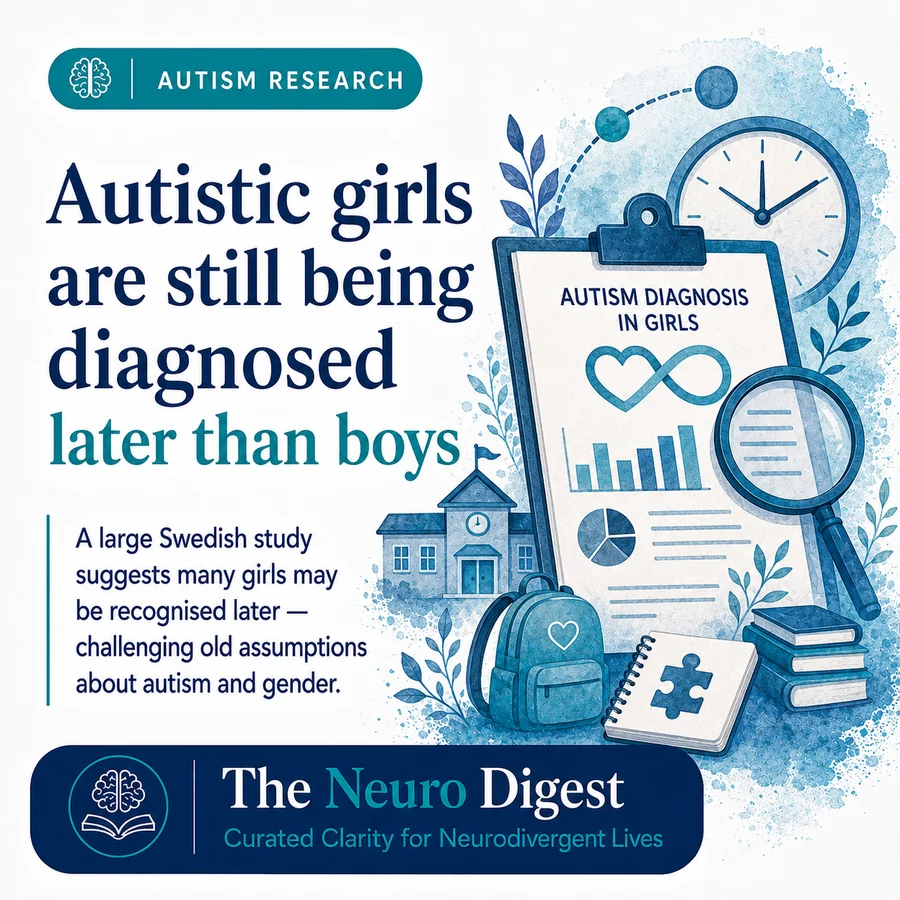
Autistic girls are still being diagnosed later than boys
A large Swedish study has challenged one of the most familiar assumptions about autism: that it is much more common in boys than girls.
The research, published in The BMJ and reported by The Guardian, looked at autism diagnoses among more than 2.7 million people born in Sweden.
It found that boys are much more likely to be diagnosed in childhood. But by early adulthood, diagnosis rates between males and females become much more equal.
That raises an important question:
Are girls less likely to be autistic, or are they simply being recognised later?
Why this matters
For decades, autism has often been understood through a male-centred lens.
The stereotypical image of autism has frequently focused on boys: visible social differences, obvious repetitive behaviours, intense interests, or difficulties that become clear early in school.
But many autistic girls do not fit that narrow picture.
Some mask their difficulties. Some copy social behaviour. Some are quiet, anxious, compliant, perfectionistic or exhausted rather than visibly disruptive. Some are misread as shy, sensitive, difficult, dramatic or mentally unwell before anyone considers autism.
That means they can be missed for years.
Later diagnosis can have a real cost
Being diagnosed later is not just an administrative delay.
It can shape a person’s whole experience of school, friendships, family life, work and mental health.
When autistic girls are not recognised, their needs may be misunderstood. They may be expected to cope with environments that overwhelm them. They may be punished for distress, praised for masking, or left to believe that struggling is a personal failure.
By the time diagnosis finally comes, many autistic girls and women have already experienced years of burnout, anxiety, isolation or misdiagnosis.
Recognition matters because it can change the story from “What is wrong with me?” to “This is how my brain works, and these are the supports I need.”
The gender gap is not simple
The study does not mean every autistic person has the same experience, or that diagnosis is now equally easy for everyone.
It also does not mean boys and men are always recognised and supported well. Many are still missed, especially if they do not fit obvious stereotypes or if their needs are hidden by other factors.
But the findings do add weight to something autistic women and girls have been saying for a long time:
The old picture of autism was too narrow.
If girls are being diagnosed later, the problem may not be that autism looks “mild” in girls. It may be that systems are less prepared to recognise how autism can present in them.
The Neuro Digest view
This is exactly why autism awareness needs to move beyond stereotypes.
It is not enough to know one version of autism. Parents, schools, clinicians and workplaces need to understand that autistic people can present in many different ways.
Some autistic girls may be loud and visibly distressed. Others may be quiet and internally overwhelmed. Some may have intense interests that look socially acceptable. Others may appear to be coping until they suddenly cannot anymore.
If support only arrives when distress becomes impossible to ignore, then the system is not identifying needs early enough.
Why we picked this
We picked this story because it challenges a common assumption in a careful, evidence-based way.
The issue is not simply whether more girls and women are being diagnosed.
The issue is whether they were always there, but not being seen.
For The Neuro Digest, this is an important reminder that late diagnosis is not just a personal story. It can also be a sign of wider gaps in how systems understand neurodivergence.
Key takeaway
Autistic girls and women may not be rare.
They may have been under-recognised, misread or diagnosed much later.
The goal should be earlier understanding, better support and a broader, more accurate picture of autism.
Sources:
The Guardian: Autistic girls much less likely to be diagnosed, study says
https://www.theguardian.com/society/2026/feb/04/autism-women-men-diagnosis-childhood-adulthood
The BMJ: Time trends in the male to female ratio for autism incidence
https://www.bmj.com/content/392/bmj-2025-084164
BMJ Group: Rates of autism in girls and boys may be more equal than previously thought
https://bmjgroup.com/rates-of-autism-in-girls-and-boys-may-be-more-equal-than-previously-thought/