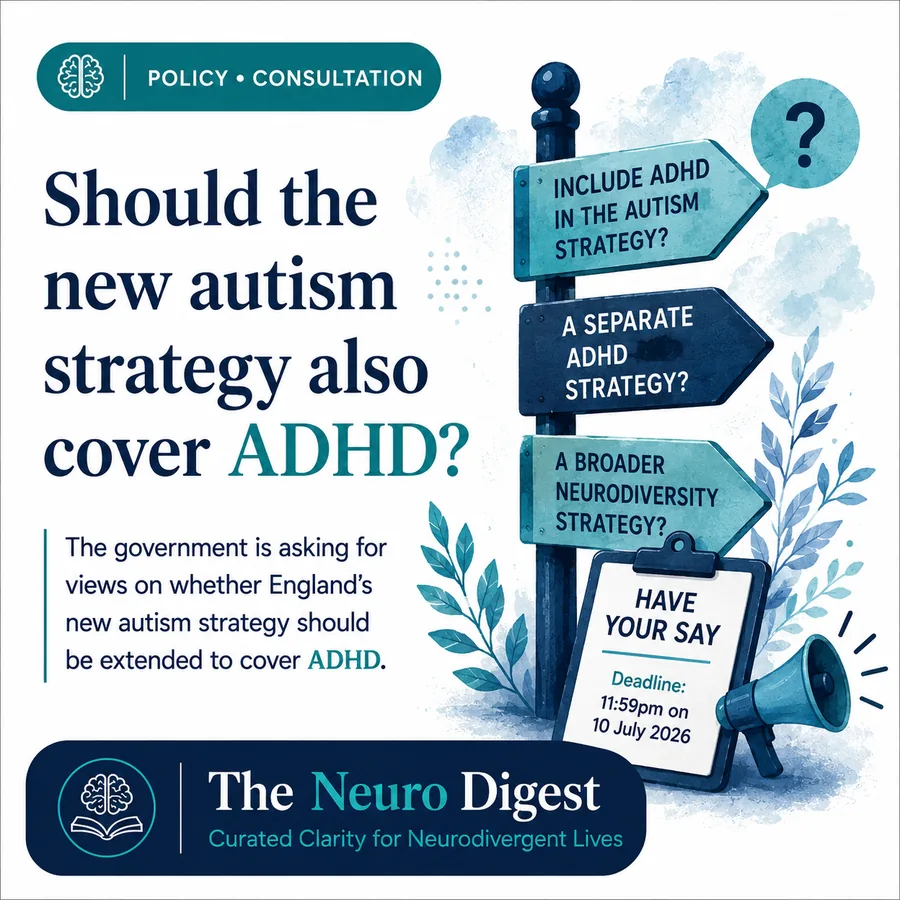
Should the new autism strategy also cover ADHD?
The government is asking whether England’s new autism strategy should also cover ADHD.
The question appears in the call for evidence for the new mental health strategy for England.
In the document, the government says it will develop and publish a new cross-government autism strategy, as required under the Autism Act 2009. It also says it will seek views on whether the new autism strategy should be extended to cover ADHD.
The call for evidence is open until 11:59pm on 10 July 2026.
Why this matters
Autism and ADHD are different conditions, but they often overlap.
Many people are autistic and ADHD. Many families are navigating both autism and ADHD assessments. Many schools, workplaces and health services are supporting people whose needs do not fit neatly into one category.
A strategy that only looks at autism may miss some of that reality.
At the same time, there is a fair question about whether ADHD should sit inside an autism strategy, have a separate ADHD strategy, or be included within a broader neurodiversity strategy.
That detail matters because strategies are not just words on paper. They can shape priorities, funding, accountability, service design, training and public understanding.
Why we picked this
This is the kind of policy question that can sound technical, but it could have real-life consequences.
If ADHD is included, it may help bring more attention to ADHD support, waiting lists, school needs, workplace adjustments and the experiences of people who are both autistic and ADHD.
But it needs to be done carefully.
ADHD should not simply be added to an autism strategy as an afterthought. Autistic people and ADHDers both need support that reflects their specific experiences, as well as the areas where their needs overlap.
A vague one-size-fits-all approach would not be enough.
Key takeaway
The government is actively asking whether the new autism strategy should also cover ADHD.
For neurodivergent people, families, clinicians, educators and employers, this is an important moment to think about what joined-up support should actually look like.
The question is not just whether autism and ADHD should be mentioned together.
It is whether policy can reflect the real complexity of people’s lives without losing sight of the specific support each group needs.
Source
GOV.UK: Informing the mental health strategy for England: call for evidence document
https://www.gov.uk/government/calls-for-evidence/informing-the-mental-health-strategy-for-england/informing-the-mental-health-strategy-for-england-call-for-evidence-document