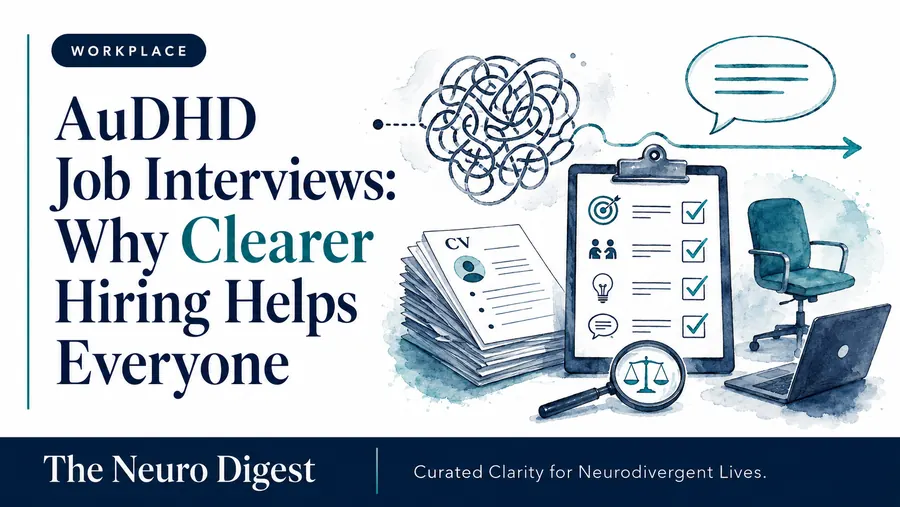
AuDHD Job Interviews: Why Clearer Hiring Helps Everyone
A recent HuffPost UK article has drawn attention to the barriers AuDHD and neurodivergent candidates can face in job interviews.
It is a useful starting point for a wider question: how much of a traditional interview is actually testing the job, and how much is testing comfort with ambiguity, speed, social convention and pressure?
For AuDHD candidates, this can matter a great deal. Someone may have the skills, insight and experience needed for a role, but still struggle in an interview format that depends heavily on quick verbal answers, indirect questions or unspoken expectations.
That does not mean the person is unsuitable. It may mean the process is not giving them a fair way to demonstrate what they can do.
Why recruitment design matters
AuDHD is commonly used to describe someone who is both autistic and ADHD. That combination can affect interviews in different ways.
An autistic candidate may prefer clear, literal communication and find vague questions harder to interpret. An ADHD candidate may have strong ideas and relevant experience, but find it difficult to organise answers quickly under pressure. Someone who is AuDHD may experience both sets of challenges, sometimes in ways that pull against each other.
This is why recruitment design matters. If an interview relies too much on instinct, “chemistry” or broad questions such as “tell us about yourself”, it can become harder to separate role ability from interview performance.
The Buckland Review of Autism Employment looked at how employers recruit, retain and develop autistic people, and identified recruitment barriers as part of the wider employment gap. Its focus was not on asking autistic people to become more typical, but on changing employer practice so more people can access work fairly.
The risk of vague criteria
One of the biggest problems with traditional interviews is that the assessment criteria are not always clear.
Employers may say they are looking for communication skills, confidence or a good team fit. But those phrases can mean very different things depending on the role.
Does “good communication” mean writing clear reports, explaining technical details, listening carefully, managing customers, presenting to senior leaders, or making small talk with a panel?
Those are not the same skill.
When criteria are vague, candidates can be judged against personal impressions rather than job-relevant evidence. That creates risk for anyone who communicates differently, including autistic, ADHD and AuDHD applicants.
The National Autistic Society has highlighted lack of understanding and negative stereotypes as major employment barriers for autistic people. Zurich UK research also found that 54% of neurodivergent adults surveyed felt recruitment processes were designed to “weed out” neurodivergent people rather than assess ability.
Reasonable adjustments should not be unusual
In the UK, disabled job applicants can ask for reasonable adjustments during recruitment. Acas says this can apply to any part of the recruitment process, including application forms, interviews and tests.
For neurodivergent candidates, adjustments might include written information about the interview format, clearer instructions, extra time for a task, questions in advance where appropriate, a quieter room, a remote interview option, or permission to use notes.
These adjustments do not lower the standard. They help remove unnecessary barriers so the candidate can be assessed more fairly.
Good employers should not wait for every candidate to disclose before making recruitment clearer. Many inclusive changes benefit everyone: structured questions, transparent criteria, accessible instructions and interviewers who know what they are actually scoring.
The CIPD’s neuroinclusion guidance encourages employers to think about neurodiversity across workplace practice, including recruitment and selection.
Clearer hiring is better hiring
Neuroinclusive recruitment is not about giving someone an unfair advantage. It is about making sure the process measures the things that matter.
If a role requires problem-solving, test problem-solving. If it requires written analysis, include a realistic written task. If it requires customer communication, be clear about what kind of communication is needed and why.
A structured process can still be rigorous. In fact, it may be more rigorous because it reduces guesswork, interviewer bias and over-reliance on first impressions.
For employers, this is not only a fairness issue. It is a talent issue. If the hiring process filters out capable people because they do not perform well in a narrow interview format, the organisation loses too.
Key takeaway
AuDHD candidates should not have to mask their way through unclear recruitment processes just to be considered fairly.
The better question for employers is not “can this person interview well?” It is “have we designed a process that lets candidates show the skills this job actually needs?”
Clearer hiring helps neurodivergent applicants. It also helps employers make better decisions.
Sources
HuffPost UK: article on AuDHD, job interviews and hiring bias. https://www.huffingtonpost.co.uk/entry/audhd-job-interviews-neurodivergence-hiring-bias-2026_uk_69ca8d7ce4b09eec10e05b32
GOV.UK: The Buckland Review of Autism Employment
https://www.gov.uk/government/publications/the-buckland-review-of-autism-employment-report-and-recommendations/the-buckland-review-of-autism-employment-report-and-recommendations
National Autistic Society: The Buckland Review of Autism Employment is published
https://www.autism.org.uk/what-we-do/news/the-buckland-review-of-autism-employment-is-publis
Zurich UK: Excluded from the job market, forced to hide their neurodiversity
https://www.zurich.co.uk/media-centre/excluded-from-the-job-market-forced-to-hide-their-neurodiversity
Acas: Reasonable adjustments at work
https://www.acas.org.uk/reasonable-adjustments
Acas: Making and handling requests for reasonable adjustments
https://www.acas.org.uk/reasonable-adjustments/asking-for-reasonable-adjustments
CIPD: Neuroinclusion at work
https://www.cipd.org/uk/knowledge/guides/neuroinclusion-work/