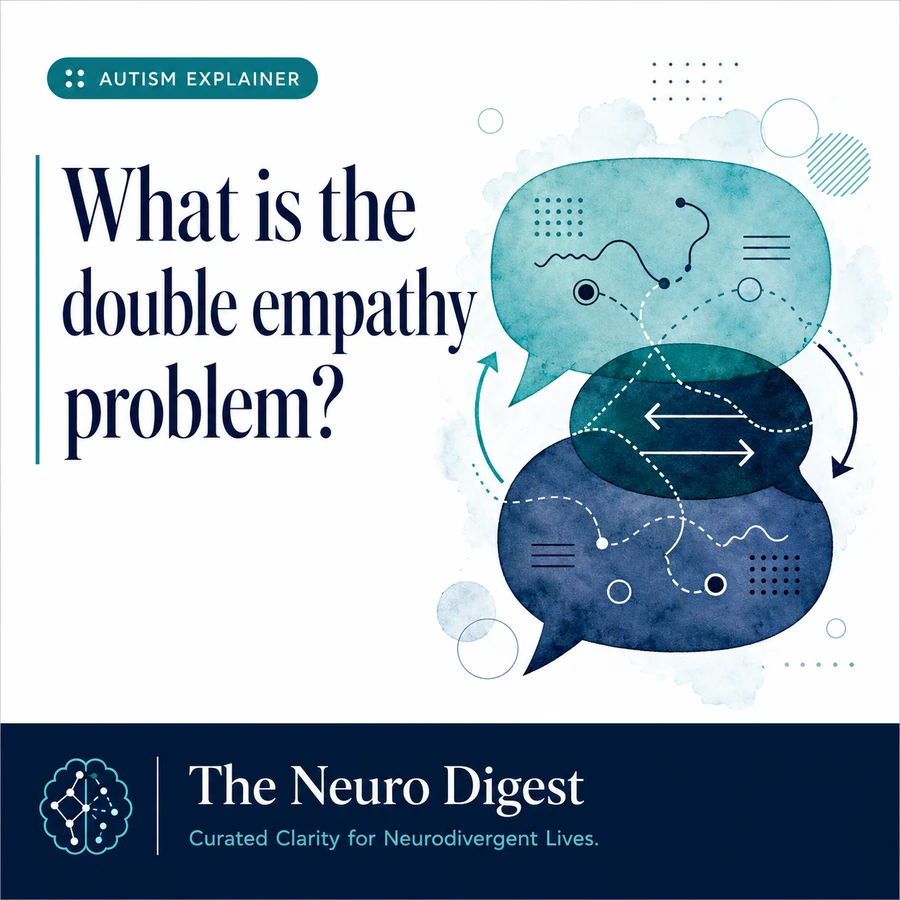
What is the double empathy problem?
The double empathy problem is one of the most useful ideas for understanding communication between autistic and non-autistic people.
At its simplest, it says that misunderstandings are often two-way.
Rather than assuming autistic people “lack social skills” or “struggle with empathy”, the double empathy problem suggests that communication can break down because autistic and non-autistic people may experience, process and express the world differently.
That difference can make it harder for both sides to read each other accurately.
Where did the idea come from?
The term was introduced by autistic researcher Dr Damian Milton in 2012. His work challenged older ideas that framed autism mainly as a one-sided social deficit. Instead, Milton argued that many difficulties between autistic and non-autistic people are better understood as a problem of mutual understanding.
In other words, the issue is not simply:
“Autistic people do not understand non-autistic people.”
It is more like:
“People with very different ways of communicating may struggle to understand each other.”
That distinction matters.
Why it matters
The double empathy problem shifts the focus away from blaming autistic people for every social misunderstanding.
For example, an autistic person might communicate directly, avoid eye contact, need longer to process a question, or show emotion in a way that does not match non-autistic expectations.
A non-autistic person might wrongly read this as rude, cold, evasive or uninterested.
But the reverse can also happen. An autistic person may find non-autistic communication confusing, indirect, inconsistent or overwhelming. They may be expected to understand hints, tone, facial expressions or social rules that are never clearly explained.
That is not one person failing. It is a mismatch.
Autistic people may communicate well with each other
One of the most interesting parts of this idea is that autistic people often report easier communication with other autistic people.
Research has supported this in several ways. A 2020 study found that information transfer between autistic people could be highly effective, challenging the assumption that autistic communication is inherently impaired. The issue appeared more strongly in mixed autistic and non-autistic groups, where communication styles were less shared.
Another study found that neurotype-matching influenced rapport, suggesting that shared communication style can matter more than whether someone is autistic or non-autistic.
This does not mean autistic people all communicate in the same way. They do not. But it does suggest that many communication difficulties are relational, contextual and mutual — not simply located inside the autistic person.
What this changes in real life
The double empathy problem has practical implications for schools, workplaces, healthcare and relationships.
It suggests that support should not only focus on teaching autistic people to appear more non-autistic. Instead, everyone involved should take some responsibility for making communication clearer and fairer.
That might mean:
Using more direct language, allowing processing time, avoiding assumptions about body language, accepting different ways of showing interest, and checking understanding rather than guessing intent.
For workplaces, this could mean not judging someone’s professionalism by eye contact, small talk or how quickly they respond in a meeting.
For schools, it could mean recognising that a child who seems blunt, quiet or withdrawn may not be being difficult. They may be communicating differently, or trying to cope with an environment that does not make sense to them.
For healthcare, it could mean clinicians listening carefully to what autistic patients actually say, rather than relying too heavily on tone, facial expression or expected social presentation.
A helpful reframe
The double empathy problem does not mean autistic people never struggle with communication. It also does not mean every misunderstanding is equal or simple.
But it does offer a more respectful starting point.
It reminds us that communication is not just about one person “getting it right”. It happens between people. When the gap is large, both sides may need to adjust.
The key takeaway is this:
Autistic communication is not automatically broken. Sometimes the real problem is that only one communication style has been treated as normal.
Sources
- Dr Damian Milton, “On the ontological status of autism: the ‘double empathy problem’”
https://www.tandfonline.com/doi/full/10.1080/09687599.2012.710008 - National Autistic Society, “The double empathy problem”
https://www.autism.org.uk/learn/knowledge-hub/professional-practice/double-empathy - Crompton et al., “Autistic peer-to-peer information transfer is highly effective”
https://journals.sagepub.com/doi/10.1177/1362361320919286 - PubMed record for Crompton et al., “Autistic peer-to-peer information transfer is highly effective”
https://pubmed.ncbi.nlm.nih.gov/32431157/ - Crompton et al., “Neurotype-Matching, but Not Being Autistic, Influences Self and Observer Ratings of Interpersonal Rapport”
https://www.frontiersin.org/journals/psychology/articles/10.3389/fpsyg.2020.586171/full - PubMed Central full text for “Neurotype-Matching…”
https://pmc.ncbi.nlm.nih.gov/articles/PMC7645034/