AuDHD Explained: How Autism and ADHD Can Interact
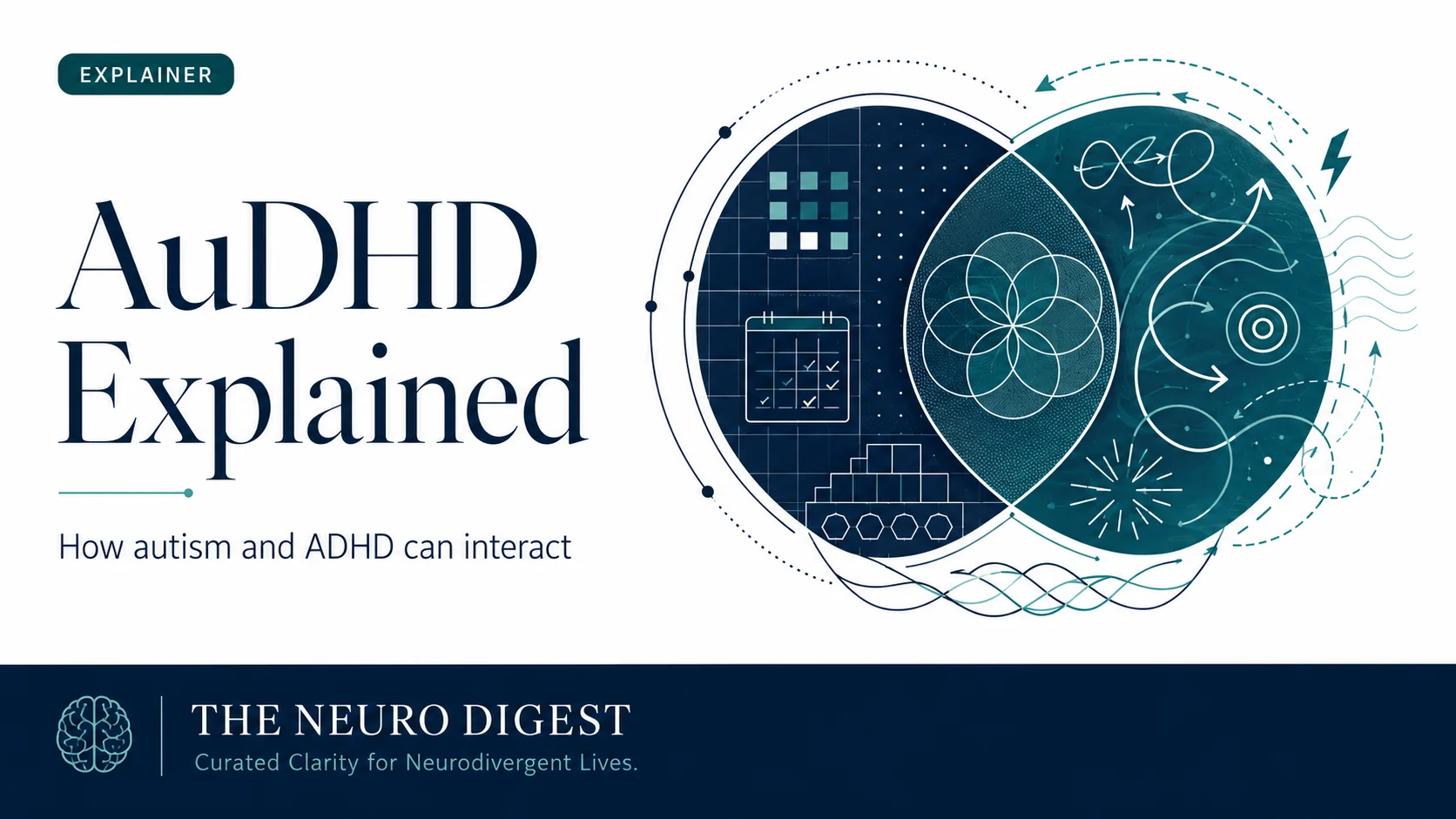
AuDHD is a community term often used by people who are both autistic and ADHD. It is not usually used as a formal medical diagnosis. Clinicians and researchers are more likely to talk about co-occurring autism and ADHD.
But as a lived-experience term, AuDHD can be useful because it points to something important: autism and ADHD do not always sit neatly side by side. Sometimes, they interact.
Autism and ADHD were once treated as separate
For many years, autism and ADHD were often treated as separate diagnostic categories. Under older diagnostic rules, someone diagnosed as autistic could be less likely to receive an ADHD diagnosis, because ADHD-like traits were often assumed to be part of autism.
That changed with DSM-5, published in 2013. Autism spectrum disorder was no longer treated as an exclusion for ADHD, meaning someone could be diagnosed with both if they met the criteria for both conditions.
That change mattered. It allowed researchers to look more directly at people who genuinely had both autism and ADHD, rather than forcing the question into “either/or” terms.
The overlap is common
Research suggests that autism and ADHD commonly overlap, although estimates vary depending on the study, the age group, and how traits are measured.
A 2022 review reported that around 50–70% of autistic people may also present with ADHD, while another meta-analysis estimated current ADHD prevalence in autistic people at around 38.5%, with lifetime prevalence around 40.2%.
The exact number varies, but the wider point is clear: co-occurring autism and ADHD is not unusual. For many people, it is part of their actual neurodevelopmental profile.
Why AuDHD can feel contradictory
One reason AuDHD can be hard to explain is that autistic and ADHD traits can appear to pull in different directions.
An autistic person may need routine, predictability and time to process change. ADHD may bring novelty-seeking, restlessness, impulsivity or difficulty sustaining attention. A person may crave structure but struggle to maintain it. They may need sameness to feel regulated, while also becoming bored or under-stimulated by too much sameness.
That does not mean the person is being inconsistent. It may mean their brain is balancing different needs at the same time.
Executive function can be more complicated
Executive function is the set of mental skills involved in planning, starting tasks, switching attention, inhibiting impulses, organising information and regulating behaviour.
Both autism and ADHD can involve executive-function differences. ADHD is often linked with attention regulation, impulsivity and inhibition. Autism can involve differences with flexibility, transitions, planning and adapting to change. But these patterns are not neat or universal, especially when someone has both conditions.
A person with AuDHD may know exactly what needs doing but still be unable to start. They may make detailed plans but struggle to follow them. They may want routine, but find the steps of maintaining that routine exhausting. They may become overwhelmed when a task involves too many decisions, interruptions or transitions.
This is one reason AuDHD can be misunderstood. From the outside, it may look like inconsistency, avoidance or lack of effort. From the inside, it may feel more like competing demands: the need for structure, the need for stimulation, the difficulty of starting, and the difficulty of switching.
Sensory processing may also matter
Sensory processing is another area where autism and ADHD can overlap.
Autistic people are often recognised as having sensory differences, such as being more sensitive to noise, light, texture, smell or unexpected touch. ADHD can also involve sensory seeking, sensory sensitivity or difficulty filtering background information.
When autism and ADHD occur together, sensory experiences may affect attention, emotional regulation and executive function. What looks like “not listening” may sometimes be sensory overload. What looks like “rigidity” may be an attempt to reduce overwhelm. What looks like “restlessness” may be a nervous system trying to regulate itself.
This does not mean every difficulty is sensory. But it does mean behaviour should not be interpreted in isolation. Environment, sensory load, fatigue and regulation all matter.
Why AuDHD can be missed
AuDHD can be missed because one condition may obscure the other.
ADHD traits may make an autistic person appear more talkative, impulsive or socially motivated than autism stereotypes suggest. Autistic traits may make an ADHD person appear more controlled, rule-bound or internally anxious than expected.
Masking can make this even harder to see. A person may look capable on the outside while using enormous effort to manage attention, sensory input, social expectations and emotional regulation. They may only appear to be coping because the cost is hidden.
This is especially relevant for people who are diagnosed later in life. Some may have spent years being told they are anxious, disorganised, difficult, too sensitive, too intense or not trying hard enough, without anyone recognising the combined autism and ADHD profile underneath.
What support needs to recognise
The important lesson is not that AuDHD is a neat third category. It is that support should be based on the person’s actual profile, not assumptions about a single diagnosis.
Someone may need structure and flexibility. Predictability and stimulation. Quiet recovery time and meaningful activity. Help with planning, but not constant pressure. Sensory adjustments, but also ways to manage under-stimulation.
AuDHD helps name that complexity. As researchers continue to study how autism and ADHD overlap, the hope is that support can move away from tidy boxes and towards understanding the whole person.
Sources
- Hours C, Recasens C, Baleyte JM. ASD and ADHD Comorbidity: What Are We Talking About? Frontiers in Psychiatry, 2022.
- Rong Y, Yang CJ, Jin Y, Wang Y. Prevalence of attention-deficit/hyperactivity disorder in individuals with autism spectrum disorder: A meta-analysis. Research in Autism Spectrum Disorders, 2021.
- Epstein JN, Loren REA. Changes in the Definition of ADHD in DSM-5: Subtle but Important.Neuropsychiatry, 2013.
- Kofler MJ et al. Executive function deficits in attention-deficit/hyperactivity disorder and autism spectrum disorder. Nature Reviews Psychology, 2024.
- Huang Z et al. Relationships between Sensory Processing and Executive Functions in Children with Combined ASD and ADHD Compared to Typically Developing and Single Disorder Groups. Brain Sciences, 2024.