ADHD and physical health: why researchers are looking beyond attention
ADHD and physical health: why researchers are looking beyond attention
ADHD is often talked about in terms of focus, impulsivity, organisation and behaviour.
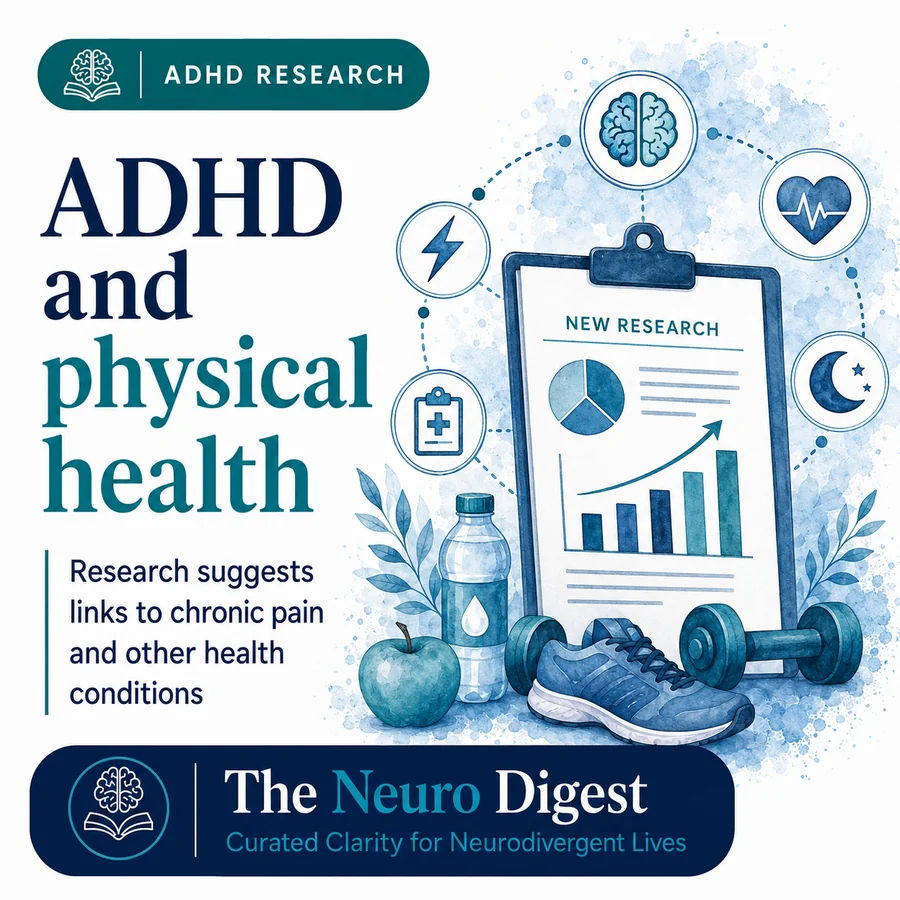
But a growing body of research is looking at something broader: whether ADHD is also linked with physical health conditions.
A recent Washington Post report highlighted research connecting ADHD with a range of other health issues, including chronic pain, anxiety, disordered eating, migraines, long covid, autoimmune disease and chronic pelvic pain.
That does not mean ADHD directly causes these conditions.
But it does raise an important question: are we still thinking about ADHD too narrowly?
Important note:
This article is about research links between ADHD and wider physical health. It is not medical advice.
A link between ADHD and another health condition does not mean ADHD causes that condition. It also does not mean people should dismiss pain, fatigue, migraines, digestive symptoms or other physical symptoms as “just ADHD”.
If you have new, severe, persistent or changing symptoms, or you are worried about your health, it is important to seek advice from a qualified medical professional.
Why this matters
For many people, ADHD is still seen mainly as a school, work or productivity issue.
That framing can miss a lot.
ADHD can affect sleep, stress, emotional regulation, memory, motivation, routines, appointments, eating patterns, medication habits and the ability to keep up with healthcare admin.
So when researchers find links between ADHD and physical health, the useful message is not panic. It is context.
ADHD may not explain every symptom. But it may shape how someone experiences symptoms, manages them, talks about them and gets help.
What the latest chronic pain study found
One of the studies highlighted looked at adults receiving treatment for persistent chronic pain in Japan.
The researchers studied 958 adults attending pain centres and screened them for ADHD and autistic traits.
They found that 17.1% screened positive for ADHD. Among people reporting extremely severe pain, that figure rose to 27.4%.
The study also found that ADHD symptoms were associated with higher pain intensity. However, the relationship appeared to be partly explained by anxiety, depression and pain catastrophising.
In plain English, that means the connection may not be simple or direct.
ADHD traits may affect how people experience, respond to or cope with pain. But mood, stress and negative thought patterns around pain may also play a role.
The researchers were careful not to say that ADHD causes chronic pain.
Instead, the study suggests that ADHD may be relevant when clinicians are trying to understand why some people experience more severe or persistent pain.
Source:
https://www.nature.com/articles/s41598-026-45300-y
University of Tokyo summary:
https://www.u-tokyo.ac.jp/focus/en/press/z0508_00449.html
Why ADHD might affect physical health
There are several possible reasons ADHD and physical health may overlap.
Some may be biological. ADHD affects brain systems involved in attention, motivation, emotional regulation and reward. These systems may also influence stress, sleep, pain sensitivity and how the body responds to discomfort.
Some may be practical. ADHD can make it harder to keep appointments, maintain routines, notice symptoms early, take medication consistently, exercise regularly, sleep well or navigate healthcare systems.
Some may be emotional. Living with unsupported ADHD can lead to chronic stress, anxiety, burnout, low self-esteem and depression. Those factors can affect physical health too.
And some may be social. People with ADHD may have years of being misunderstood, dismissed or told they are lazy, chaotic or not trying hard enough. That can make it harder to ask for help, describe symptoms clearly or feel believed.
This does not mean every health problem is “because of ADHD”.
It means ADHD may shape the context around someone’s health.
The wider research picture
The chronic pain study is not the only research pointing in this direction.
A large Swedish register-based study found that adults with ADHD had increased risk across a wide range of physical health conditions. The strongest associations included nervous system disorders, respiratory conditions, musculoskeletal conditions and metabolic diseases.
Again, this does not prove direct cause and effect.
But it supports the idea that ADHD is not just about concentration at school or productivity at work. It can sit alongside wider patterns of physical and mental health.
This also fits with what many ADHD adults describe from lived experience.
Poor sleep. Exhaustion. Anxiety. Tension. Digestive issues. Pain that is hard to explain. Difficulty keeping up with healthcare admin. Feeling overwhelmed before even getting to the appointment.
The research is beginning to catch up with what many people have been saying for years: ADHD can affect daily life in ways that go far beyond attention.
Source:
https://news.ki.se/adult-adhd-is-linked-to-numerous-physical-conditions
Study:
https://pmc.ncbi.nlm.nih.gov/articles/PMC8376653/
What this does not mean
This kind of research needs careful wording.
A link between ADHD and another health condition does not mean ADHD directly causes that condition.
It also does not mean every person with ADHD should expect to develop chronic pain or long-term illness.
Why we picked this
We picked this story because it helps challenge a narrow view of ADHD.
ADHD is often discussed as if it is only about paying attention, sitting still or meeting deadlines.
But for many people, ADHD affects the practical systems that keep life and health on track: sleep, planning, appointments, eating, exercise, stress management, emotional regulation and follow-up care.
That does not make ADHD the cause of every health problem.
But it does mean ADHD should be considered as part of the bigger picture.
Key takeaway
This research does not mean ADHD causes chronic pain or other health conditions.
But it does suggest that ADHD and physical health may be more connected than many people realise.
For some people, ADHD may affect how pain is experienced, how symptoms are managed, how healthcare is accessed and how stress builds up over time.
The bigger message is not panic.
It is recognition.
ADHD is a neurodevelopmental condition, but its impact can be whole-body, whole-life and deeply practical.
Understanding that could help more people get support that actually fits the way they live.
Sources
Washington Post: “Researchers are uncovering ADHD’s links to these other health conditions”
https://www.washingtonpost.com/wellness/2026/06/14/adhd-is-linked-chronic-pain-other-health-conditions/
Scientific Reports: “Attention-deficit/hyperactivity disorder and autism spectrum disorder symptoms in patients with chronic pain”
https://www.nature.com/articles/s41598-026-45300-y
University of Tokyo: “ADHD and chronic pain, an overlooked connection”
https://www.u-tokyo.ac.jp/focus/en/press/z0508_00449.html
Karolinska Institutet: “Adult ADHD is linked to numerous physical conditions”
https://news.ki.se/adult-adhd-is-linked-to-numerous-physical-conditions
Full study on ADHD and physical health conditions:
https://pmc.ncbi.nlm.nih.gov/articles/PMC8376653/
NHS: “Attention deficit hyperactivity disorder”
https://www.nhs.uk/conditions/attention-deficit-hyperactivity-disorder-adhd/
NICE guideline: “Attention deficit hyperactivity disorder: diagnosis and management”
https://www.nice.org.uk/guidance/ng87