Stimming and Autism: Research Is Asking a Different Question
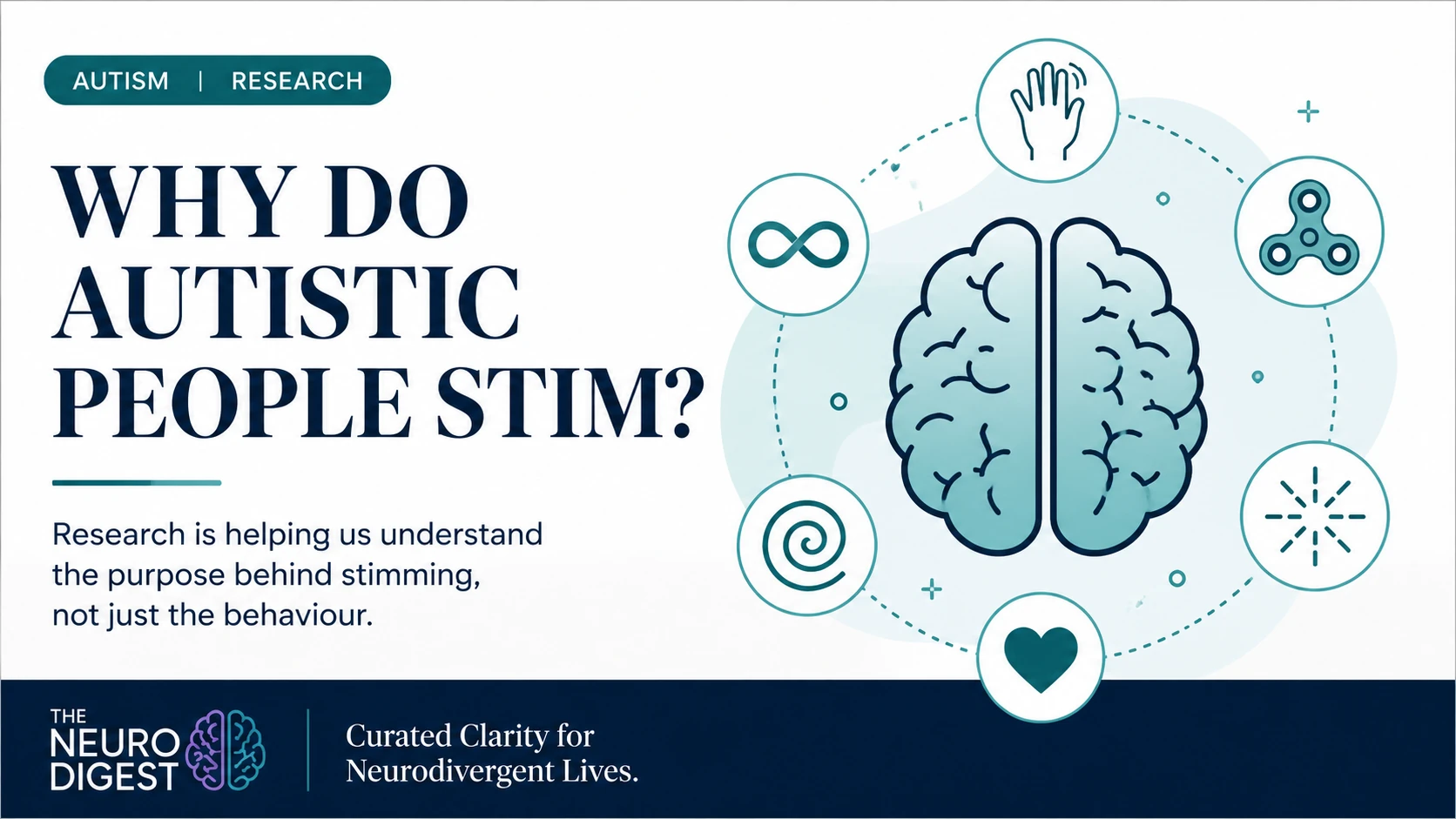
Stimming is often described as repetitive movement or behaviour.
Hand flapping, rocking, pacing, tapping, repeating sounds or fidgeting with objects are all examples that people may associate with stimming.
But those descriptions only tell us what stimming looks like. They don’t explain why people do it.
Increasingly, researchers are asking autistic people that question instead – and the answers are helping to build a better understanding of the role stimming can play in everyday life.
More than repetitive behaviour
Stimming, short for self-stimulatory behaviour, has long been recognised as a common autistic trait.
For many years, research focused on observing these behaviours from the outside and classifying them as “restricted and repetitive behaviours”.
More recent research is taking a different approach by asking autistic people about their own experiences.
The 2025 study Autistic Experiences and Perceptions of Stimming explored how autistic adults viewed stimming and the role it plays in everyday life. Rather than seeing it as simply a behaviour to eliminate, participants described a much more complex picture. Only a small minority viewed stimming as generally negative, while many said its impact depended on the situation.
What does stimming do?
Earlier research by Steven K. Kapp and colleagues found that autistic adults often described stimming as a way to regulate emotions, manage sensory experiences and express thoughts or feelings that may be difficult to communicate in other ways.
In other words, a behaviour that looks unusual to someone else may be serving an important purpose for the person doing it.
The National Autistic Society also explains that autistic people may stim to regulate sensory input, stay calm or express emotions such as excitement or joy. Its guidance advises against trying to stop self-regulatory stimming unless it is causing harm.
Why this matters
This shift in research reflects a broader change in autism research.
Instead of only asking, “How do we reduce this behaviour?”, researchers are increasingly asking, “Why is this person doing it?”
That difference matters.
Some forms of stimming can cause injury or interfere with daily life and may require support. But harmless stimming should not automatically be viewed as something that needs correcting simply because it looks different.
Understanding the purpose of a behaviour is often the first step towards providing the right support.
Why we picked this
Stimming is often misunderstood because people see the behaviour but not the reason behind it.
We picked this research because it reflects a wider shift in autism research towards listening to autistic people’s own experiences. Rather than focusing only on what stimming looks like, researchers are increasingly asking what purpose it serves and what it means to the individual.
Key takeaway
Stimming is more than a repetitive behaviour.
For many autistic people, it can be an important way of regulating emotions, managing sensory input and expressing themselves.
As research evolves, understanding why someone stims may be just as important as recognising that they do.
Sources
Gillespie-Lynch, K., et al. (2025). Autistic Experiences and Perceptions of Stimming. Autism & Developmental Language Impairments.
https://journals.sagepub.com/doi/10.1177/27546330241311096
Kapp, S. K., Steward, R., Crane, L., et al. (2019). People Should Be Allowed to Do What They Like: Autistic Adults’ Views and Experiences of Stimming. Autism.
https://pmc.ncbi.nlm.nih.gov/articles/PMC6728747/
National Autistic Society. Stimming.
https://www.autism.org.uk/advice-and-guidance/about-autism/repeated-movements-and-behaviour-stimming