Shaun Ryder on ADHD, late diagnosis and being misunderstood
Shaun Ryder’s recent comments about ADHD, neurodiversity and the Happy Mondays offer more than a music headline.
They point to a bigger issue: how many neurodivergent people spend years being misunderstood before anyone gives them language for what is actually going on.
Ryder, best known as the frontman of Happy Mondays and Black Grape, was diagnosed with ADHD later in life. In recent interviews, he has reflected on how ADHD and neurodivergence may have shaped his own life, while also making wider comments about family, creativity and the Happy Mondays.
But the most important part of the story is not whether every member of a famous band was neurodivergent.
It is what late diagnosis can do to a person’s understanding of their own life.
Why this matters
Many people diagnosed with ADHD, autism, dyslexia or other neurodivergent conditions in adulthood describe a similar experience.
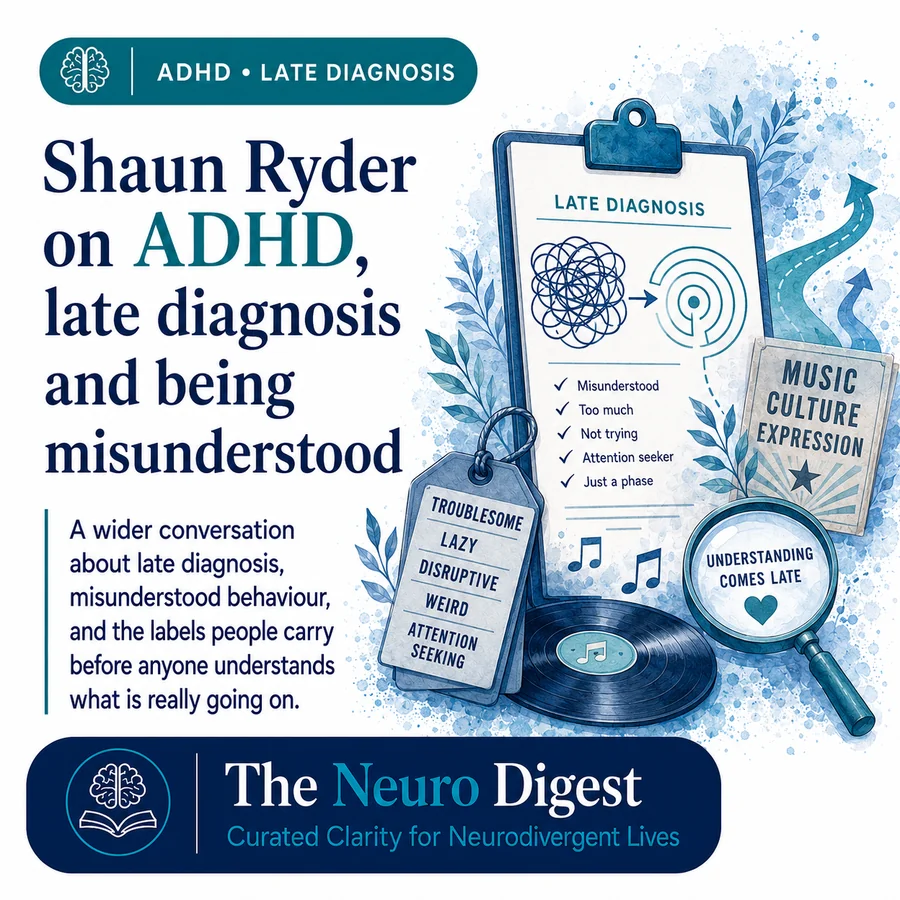
Before diagnosis, they may have been called lazy, disruptive, difficult, chaotic, unreliable, oversensitive, careless or simply “too much”.
After diagnosis, the past can start to look different.
That does not mean every difficult moment is explained away. It does not mean behaviour has no consequences. But it can give context to patterns that may have been misunderstood for decades.
For people like Ryder, who grew up at a time when ADHD and dyslexia were far less recognised in schools, this matters.
A child who struggled to sit still may have been seen as naughty.
A child who struggled to read may have been seen as not trying.
A young adult who chased stimulation, novelty or intensity may have been seen only through the lens of recklessness.
For many late-diagnosed adults, the diagnosis does not rewrite the past. But it can help explain why the past felt so hard to live through.
From “difficult” to understood
One of the most powerful things about late diagnosis is the change in language.
The same traits can be described in very different ways depending on whether people understand neurodivergence.
Restlessness can become a need for movement.
Impulsivity can become a difficulty with inhibition.
Forgetfulness can become a working memory challenge.
Avoidance can become overwhelm.
A need for stimulation can become part of how a brain regulates attention and energy.
This does not mean every label disappears. It means the story becomes more accurate.
That accuracy can be especially important for people who spent years believing they were simply broken, lazy or bad.
The risk of diagnosing other people from the outside
There is also a useful caution in this story.
Ryder has spoken openly about his own ADHD diagnosis. That is his story to tell.
But when public figures talk about friends, relatives or bandmates as neurodivergent, it raises a more delicate point.
Neurodivergence can run in families. People may recognise traits in others once they understand their own diagnosis. But unless someone has chosen to share a diagnosis or identity publicly, it is better not to state it as fact.
That distinction matters.
We can talk about Ryder’s reflections. We can talk about how neurodivergent people often recognise familiar traits in others. We can talk about the wider pattern of late-recognised ADHD and dyslexia.
But we should still be careful not to diagnose people from a distance.
Creativity, chaos and neurodivergence
There is a long-running temptation to romanticise neurodivergence, especially when talking about musicians, artists and performers.
ADHD can be linked with energy, spontaneity, risk-taking, verbal creativity and intense focus when something is interesting. But it can also involve exhaustion, emotional dysregulation, addiction risk, financial difficulty, relationship strain and years of internal shame.
That nuance matters.
The point is not that ADHD made someone famous.
The point is that a creative, intense or chaotic public image may sometimes sit on top of very real lifelong struggles.
For neurodivergent people, especially those diagnosed late, that can feel familiar.
People may see the humour, the energy or the talent. They may not see the effort it takes to function, recover, regulate or keep going.
Why we picked this
We picked this story because it shows how public conversations about ADHD are changing.
More adults are looking back at their lives and asking whether the labels they were given were ever the right ones.
More families are recognising patterns across generations.
More people are realising that support, understanding and diagnosis often arrived far too late.
Shaun Ryder’s comments will attract attention because of who he is. But the wider issue is relevant far beyond music.
It is about what happens when people are judged for years before anyone understands their brain.
Key takeaway
Late diagnosis does not erase the past.
But it can change the meaning of it.
For many neurodivergent adults, finally having the right words can turn a lifetime of “what is wrong with me?” into a more compassionate question:
“What support did I need, and why did no one see it sooner?”
That is a conversation worth having.
Sources
Yahoo News / The Independent: https://uk.news.yahoo.com/shaun-ryder-says-neurodiversity-brought-104132415.html
The Independent: https://www.independent.co.uk/arts-entertainment/music/news/shaun-ryder-happy-mondays-bez-b2940789.html
Disability Horizons interview: https://disabilityhorizons.com/2022/05/happy-mondays-frontman-shaun-ryder-on-being-a-rockstar-with-adhd/