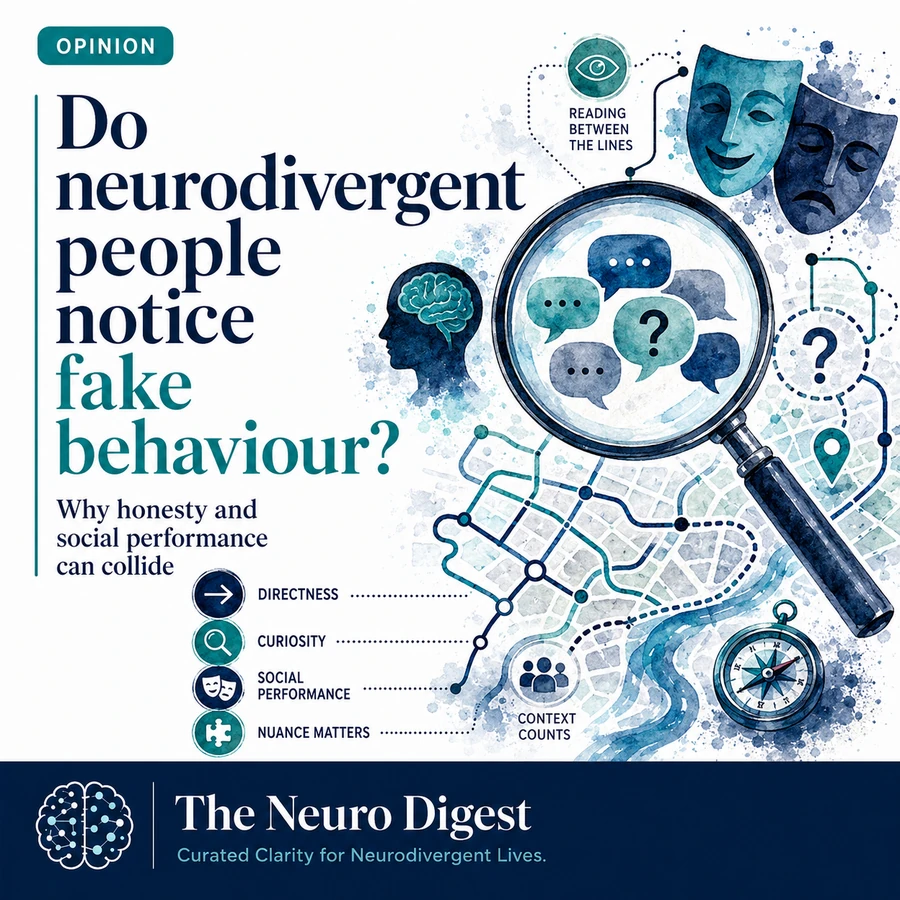
Are neurodivergent people more likely to notice when something feels fake?
At The Neuro Digest, we regularly see posts online saying things like:
“Neurodivergents are direct and curious, which triggers a lot of people who are fake and performative.”
It is easy to see why this kind of post gets shared.
For many autistic people, ADHDers and other neurodivergent people, the idea feels familiar. They may recognise the experience of asking direct questions, noticing inconsistencies, or feeling uncomfortable when social interactions seem vague, forced or insincere.
But is the statement actually true?
As usual, the answer is more complicated than a quote graphic can capture.
Why this idea resonates
For some neurodivergent people, directness is not rudeness. It is clarity.
A person may ask:
“Why are we doing it that way?”
“What does that actually mean?”
“Is that the real reason?”
“Can you be more specific?”
Those questions are not necessarily challenges. They may simply be attempts to understand.
But in environments where people rely heavily on unspoken rules, social hierarchy, polite vagueness or indirect communication, direct questions can land badly.
Curiosity can be mistaken for criticism.
Clarity can be mistaken for confrontation.
Honest questions can be treated as a threat.
That mismatch can leave neurodivergent people feeling confused, because they may have been trying to understand rather than attack.
Why “fake” behaviour can feel uncomfortable
Many neurodivergent people also describe struggling with social performance.
Small talk, forced enthusiasm, vague niceness, office politics, hidden expectations and indirect criticism can all feel exhausting. For some people, it can feel like everyone else has been given a social script they never received.
This does not mean neurotypical people are fake.
It means some common social behaviours can feel confusing, artificial or unsafe when you process communication differently.
It can also work the other way round. A neurodivergent person who is honest, quiet, blunt, intense or literal may be wrongly judged as rude, cold, difficult or confrontational.
Often, the issue is not bad intention on either side. It is different communication styles colliding.
But we need to be careful with blanket claims
The problem with the quote is not that it contains no truth.
The problem is that it turns a real experience into a sweeping rule.
Not all neurodivergent people are direct.
Not all neurotypical people are fake.
Not every uncomfortable reaction means someone has been exposed.
And not every direct question is harmless in its impact.
Neurodivergent people can be performative too. Many have spent years masking, copying social behaviour, suppressing their needs or trying to appear “normal” in order to get through school, work, family life or social situations.
So the idea that neurodivergent people are automatically authentic while everyone else is fake is too simple.
Life is messier than that.
What this post is really pointing to
Even so, there is something important underneath the quote.
Many neurodivergent people do notice when words, tone, behaviour and actions do not line up. Some are highly sensitive to inconsistency, unfairness or rules that seem arbitrary.
That can be a strength.
It can also be tiring.
Because noticing something does not always mean being believed. Asking for clarity does not always mean getting a clear answer. And being direct does not always mean being understood.
In some workplaces, families or social groups, the person asking honest questions may be labelled as the problem, even when the real issue is unclear communication, defensiveness or hidden expectations.
A more balanced way to say it
Rather than saying:
“Neurodivergent people trigger fake people.”
Maybe the better version is:
“Some neurodivergent people communicate directly, ask clarifying questions and notice inconsistencies. In environments built around indirectness or social performance, that can create discomfort — especially when clarity is mistaken for criticism.”
That leaves more room for nuance.
It validates the experience without turning it into an us-versus-them claim.
Key takeaway
There may be truth in the idea that some neurodivergent people are direct, curious and sensitive to inconsistency.
But that does not mean neurodivergent people are always truthful, or that everyone who feels uncomfortable is fake.
The better question is not:
“Who is real and who is performative?”
It is:
Why is directness so often treated as aggression?
Why are honest questions sometimes seen as a threat?
And how can we create spaces where asking for clarity is not treated as a problem?