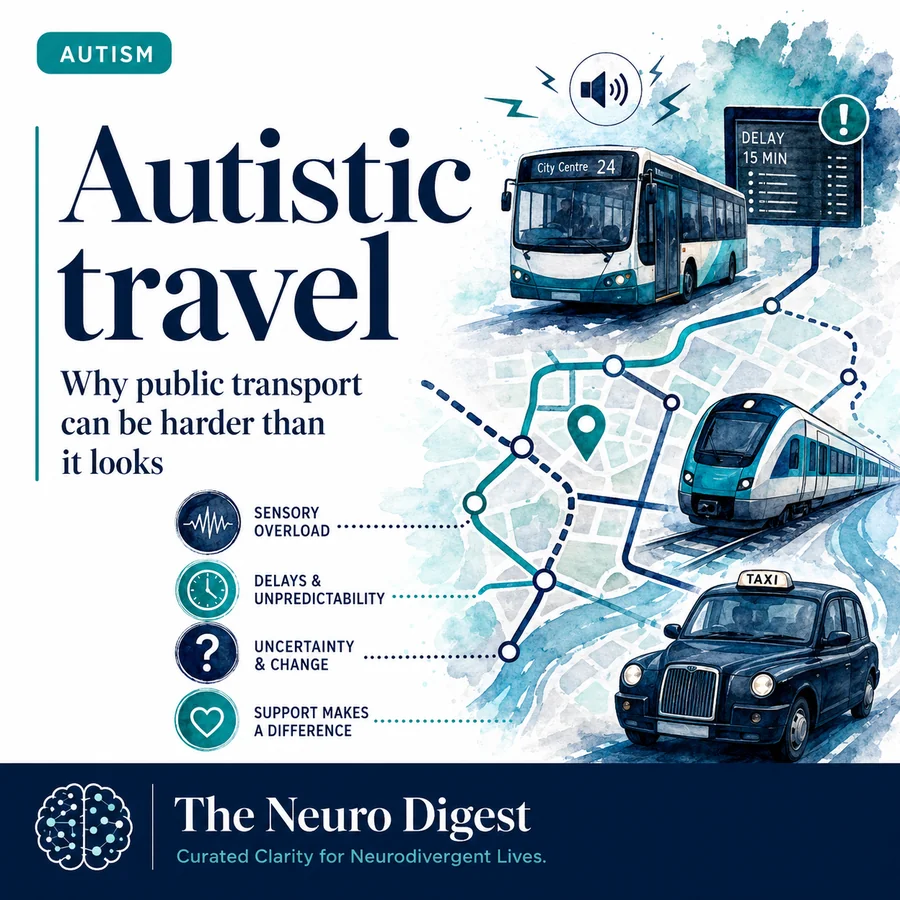
Autistic travel: why public transport can be harder than it looks
For some people, public transport is just a way of getting from one place to another.
For many autistic people, it can be much more complicated.
A new research project from the National Autistic Society has looked at autistic adults’ experiences of travel and transport in the UK.
The project, funded by the Motability Foundation, explored the barriers autistic people can face when using trains, buses, taxis and similar forms of transport. It also looked at the impact those barriers can have, and what might make services more accessible and autism-friendly.
The National Autistic Society says the project began in April 2024 and used a participatory, user-led approach, including surveys, interviews, focus groups and workshops. A co-design group of autistic people helped steer the project and review draft documents.
Source: National Autistic Society — Empowering Autistic Travel
https://www.autism.org.uk/what-we-do/who-we-are/research/empowering-autistic-travel
What did the research find?
One of the headline findings is striking.
The National Autistic Society says that 87% of autistic people find it difficult or impossible to use buses or trains.
The project heard from more than 4,000 autistic people and their families, as well as transport providers and professionals.
The barriers described will feel familiar to many autistic people and families. Public transport can involve crowds, noise, strong smells, bright lights, unclear announcements, last-minute changes, delays, cancellations, and the stress of being close to strangers.
It can also involve social pressure. Asking for help, explaining needs, speaking to staff, dealing with other passengers, or having to respond quickly when plans change can all make journeys more difficult.
Why this matters
This is not just about travel being unpleasant.
If public transport is overwhelming, confusing or unpredictable, it can affect almost every part of life.
It can make it harder to get to work, attend appointments, access education, visit friends, take part in hobbies, or simply travel independently.
The National Autistic Society says lack of accessible transport can lead to harder access to education, work and leisure, greater social isolation, lower confidence, and meltdowns or extreme distress during or after journeys.
That is why this matters. For autistic people, travel difficulties are not always just personal preference or anxiety. They can be accessibility issues.
Accessibility is not only physical
When people talk about accessible transport, they often think about ramps, lifts, step-free access and wheelchair spaces.
Those things are very important.
But for autistic people, accessibility can also mean predictability, clear information, sensory awareness, patient staff, quieter spaces, and different ways to ask for help.
A bus, train or taxi can be physically accessible but still feel impossible to use if the journey is too loud, too crowded, too uncertain or too socially demanding.
What could help?
The research points towards practical changes that could make travel easier for autistic passengers.
These include clearer information before and during journeys, better support during delays or cancellations, easier journey planning, staff who understand autism, quiet or safer spaces where possible, and ways to ask for help without needing to speak.
Small changes can make a big difference.
Knowing what to expect can reduce anxiety. Clear updates during disruption can help someone re-plan. A quieter place to wait can help someone regulate. Staff who respond calmly and patiently can make a difficult moment much easier.
Why we picked this
We picked this because travel is one of those everyday issues that can easily be underestimated.
Many people assume public transport is accessible if someone can physically get on board.
But for autistic people, the barriers may be sensory, social, emotional and informational.
This research is useful because it explains why public transport can be difficult, rather than simply saying that it is. It also points towards practical changes that could make journeys safer, calmer and more manageable.
Key takeaway
Public transport should not only be physically accessible.
It should also be understandable, predictable and manageable.
For autistic people, better travel accessibility might mean clearer information, quieter spaces, patient staff, better support when plans change, and less pressure to communicate in only one way.
And as with many accessibility improvements, changes that help autistic people are likely to help many other passengers too.
Source:
National Autistic Society — Empowering Autistic Travel
https://www.autism.org.uk/what-we-do/who-we-are/research/empowering-autistic-travel