Why children need support based on needs, not just labels
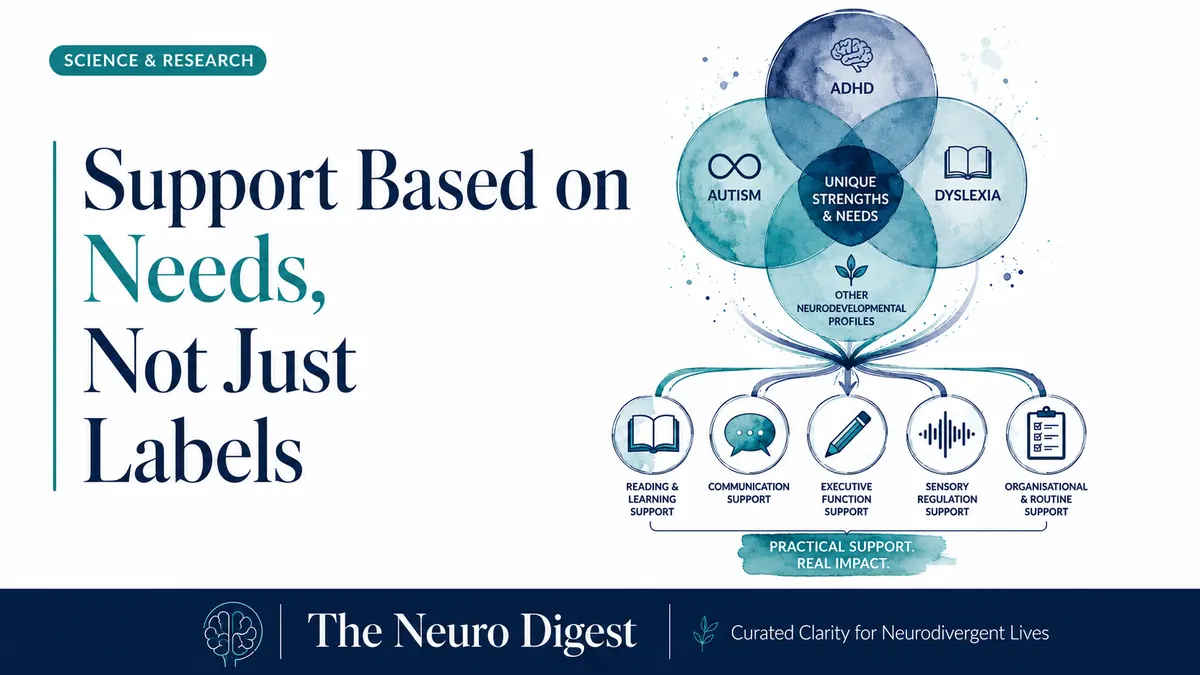
A new UK study has suggested that ADHD, autism, dyslexia and related developmental traits may be better understood as part of a broader “neurodevelopmental spectrum”, rather than treated as completely separate boxes.
The research, led by Queen Mary University of London and Royal Holloway, University of London, used data from more than 10,000 children in the UK Twins Early Development Study. It looked at how traits linked to different neurodevelopmental conditions overlap, and how those traits relate to later outcomes such as school achievement and SEND status.
What did the study find?
The researchers found that traits usually associated with different diagnoses often cluster together.
That means a child may have attention differences, social communication differences, learning difficulties, language needs or motor challenges in overlapping ways. This will not surprise many families, teachers or neurodivergent adults. In real life, children rarely arrive in neat diagnostic categories.
A child might have an ADHD diagnosis but also struggle with reading, sensory overload or social communication. Another child might be autistic but also have significant attention, anxiety, language or coordination difficulties. Some children may not have a diagnosis at all, but still have a clear pattern of support needs.
Why this matters
The study does not mean diagnoses are pointless. Diagnosis can be important for understanding, identity, legal protections and access to support.
But it does challenge the idea that support should only begin once a child has the “right” label.
That matters because families often spend months or years trying to get a child assessed. During that time, the child may still be struggling every day with schoolwork, transitions, friendships, sensory environments or emotional regulation.
If systems wait for a single diagnosis before offering help, children with mixed or less obvious profiles can be missed.
Needs do not always match labels
One of the most useful messages from this research is that a child’s support should be based on what they are actually experiencing.
For example, if a child cannot manage noisy classrooms, they may need sensory adjustments whether their diagnosis is autism, ADHD, dyslexia or something else. If a child cannot organise tasks, they may need executive function support whether the formal label has arrived or not.
The label can help explain the pattern. But the needs are still real before the label exists.
The risk of separate boxes
Schools, health services and support systems are often organised by category. Autism pathway. ADHD pathway. Dyslexia assessment. Speech and language referral. Occupational therapy referral.
Each pathway may make sense on paper. But for families, it can feel like being passed from door to door while the child’s actual day-to-day difficulties remain unresolved.
The neurodevelopmental spectrum idea does not remove the need for specialist knowledge. It simply reminds us that children are whole people, not separate files.
Key takeaway
The practical lesson is not complicated.
We need to keep diagnoses where they help, but stop treating them as the only route to support.
A child who is struggling with attention, communication, learning, sensory processing, movement or emotional regulation should not have to fit perfectly into one box before adults respond.
Support should start with the child in front of us: what helps them learn, feel safe, communicate, regulate and take part?
That is not lowering expectations. It is making expectations more realistic, more humane and more likely to work.
Sources
Royal Holloway, University of London: New paper suggests experts should focus on a “neurodevelopmental spectrum” to support children rather than considering conditions in isolation.
https://www.royalholloway.ac.uk/about-us/news/new-paper-suggests-experts-should-focus-on-a-neurodevelopmental-spectrum-to-support-children-rather-than-considering-conditions-in-isolation
Queen Mary University of London: Experts should focus on a “Neurodevelopmental spectrum” to support children rather than considering conditions like ADHD and autism in isolation.
https://www.qmul.ac.uk/news/latest-news/2026/science-and-engineering/se/experts-should-focus-on-a-neurodevelopmental-spectrum-to-support-children-rather-than-considering-conditions-like-adhd-and-autism-in-isolation.html
Molecular Psychiatry: The neurodevelopmental spectrum.
https://www.nature.com/articles/s41380-026-03714-0