
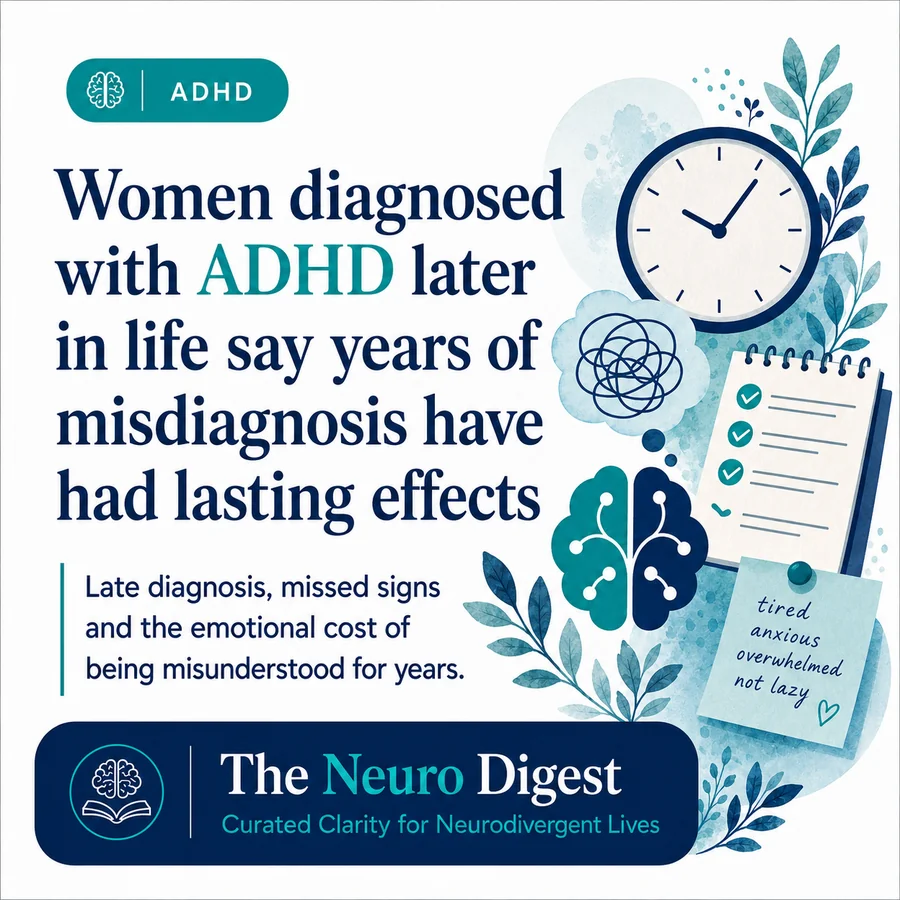
Why ADHD Is Still Being Missed in Women
A recent BBC report highlights an issue that many women with ADHD will recognise immediately: being diagnosed late, often after years of anxiety, depression, burnout, self-blame or feeling as though they were somehow “not coping” with life properly.
The article focuses on women who were only diagnosed with ADHD later in adulthood, after years of being misunderstood or misdiagnosed. But the wider message is bigger than any individual story.
Many women with ADHD are not missed because they are not struggling. They are missed because their struggle is hidden behind coping strategies, overwork, perfectionism, people-pleasing and years of trying to appear fine.
Why ADHD can be missed in women
ADHD is still often understood through an outdated stereotype: the visibly hyperactive boy who cannot sit still in class.
But ADHD does not always look like that.
In women and girls, ADHD may be less obvious from the outside. It can show up as chronic overwhelm, emotional exhaustion, difficulty starting tasks, time blindness, forgetfulness, restlessness, disorganisation, rejection sensitivity, burnout or a constant sense of being behind.
Some women become extremely good at masking these difficulties. They may use lists, alarms, routines, over-preparation, long working hours or perfectionism to keep everything together. From the outside, they may appear organised and capable. Behind the scenes, the effort required to maintain that appearance can be enormous.
That is one reason ADHD in women can be mistaken for anxiety, depression or simply “not coping”.
The cost of late diagnosis
Late diagnosis is not just about finally getting a label. For many women, it can reshape how they understand their whole life.
Years of undiagnosed ADHD can leave people believing they are lazy, unreliable, too emotional, disorganised or broken. When the real issue is not a lack of effort, but a neurodevelopmental condition that was not recognised.
The BBC article also highlights burnout as a major theme. This matters because many women do manage to function for years — but often at a significant cost. Holding everything together can come with exhaustion, anxiety, low self-esteem and a nervous system that is constantly under pressure.
A late diagnosis can bring grief as well as relief. Relief that there is an explanation. Grief for the years spent blaming yourself.
Why this matters too
This is not only a personal issue. It is a systems issue.
If diagnostic criteria, professional awareness and public understanding are still shaped around how ADHD has traditionally appeared in boys and men, then women and girls are more likely to be missed.
The problem is not simply that women did not speak up loudly enough. Many did speak up. They spoke about anxiety, depression, overwhelm, exhaustion, emotional distress and not being able to manage daily life. But ADHD was not always considered as part of the picture.
That means the question should not only be: “Why were these women missed?”
It should also be: “What were professionals, schools, workplaces and services trained to look for — and what were they not seeing?”
Why we picked this
We picked this BBC report because it captures one of the biggest issues in adult ADHD: many women are diagnosed only after years of masking, burnout and being treated for something else.
It is also a useful reminder that someone can look successful, organised or capable and still be struggling intensely underneath.
For The Neuro Digest, this is exactly the kind of story worth sharing: not because late diagnosis is a trend, but because for many people it is the first time their life finally makes sense.
Key takeaway
Women with ADHD may appear to be coping from the outside while privately using huge amounts of energy to keep up.
Late diagnosis is not just about missed symptoms. It can affect mental health, self-esteem, work, relationships and a person’s entire understanding of themselves.
The more we understand how ADHD can present in women, the better chance there is that people will be recognised earlier — before years of burnout and self-blame.
Source: BBC News
https://www.bbc.co.uk/news/articles/c1my9emmk0eo