Quiet hours: when shops turn the volume down
Some shops are not just busy.
They are loud, bright, crowded, scented, unpredictable and full of things competing for your attention.
For many neurodivergent people, that can make shopping much harder than it looks from the outside. It is not always the shopping itself that is the problem. It is the environment around it.
That is why Sephora UK’s quiet hours trial is an interesting one to cover.
The beauty retailer has been trialling quieter shopping periods in selected UK stores, including changes such as lower music, reduced screen activity and a calmer sensory environment. The trial was reported by the British Beauty Council, with Sephora describing it as a response to feedback from neurodivergent customers and staff.
What are quiet hours?
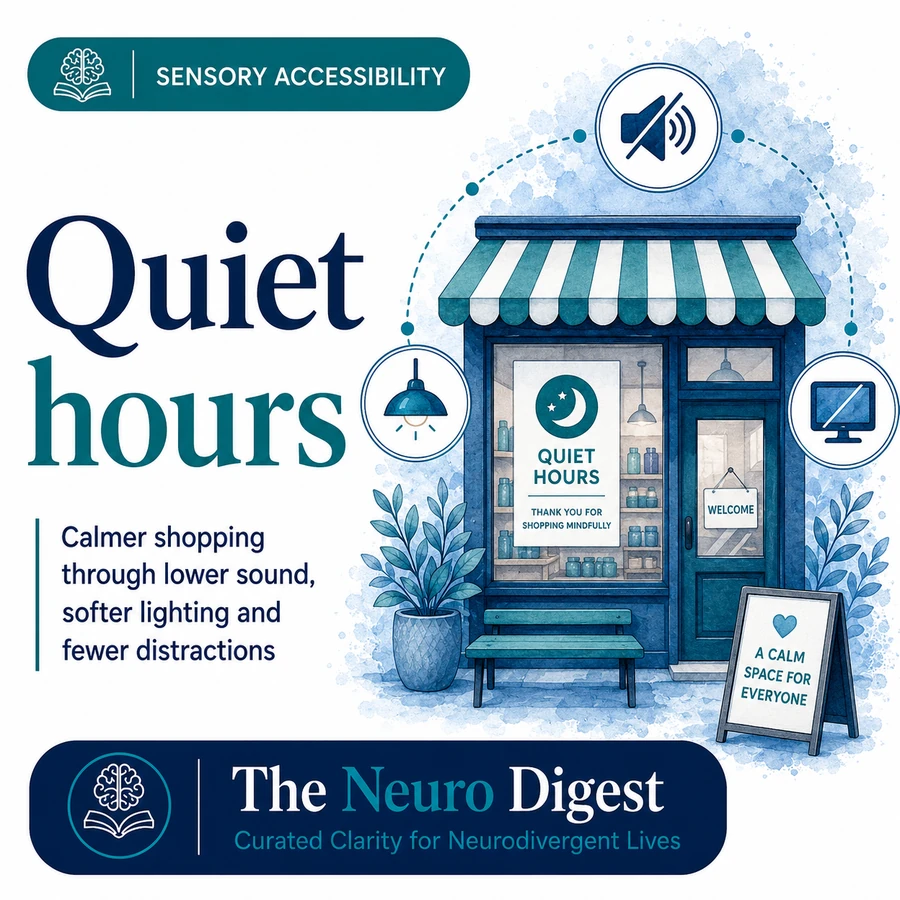
Quiet hours are set times when a shop reduces some of the sensory input that can make the space feel overwhelming.
That might include turning music down, reducing announcements, softening lighting where possible, limiting screen movement, or making the general atmosphere feel calmer.
In Sephora UK’s case, the trial has been reported as running in selected stores on Tuesday and Thursday mornings.
It is a simple idea. But for some people, simple changes can be the difference between being able to use a space and avoiding it completely.
Why this matters
Accessibility is often talked about as though it only means physical access.
Ramps, lifts, toilets and step-free routes matter hugely. But they are not the whole picture.
A space can be physically open while still being very difficult for some people to tolerate.
For autistic people, ADHDers, people with sensory processing differences, anxiety, migraine, fatigue or other conditions, the sensory environment can become a barrier in its own right.
Loud music might make it harder to think. Bright lighting might feel painful. Strong smells might be overwhelming. Crowds might make it difficult to move, choose, queue or communicate.
Quiet hours recognise that the environment itself can either help or hinder people.
Not everyone needs the same thing
It is important not to overgeneralise.
Not every neurodivergent person wants a quiet shop. Some people enjoy busy, stimulating spaces. Others may prefer quiet but still need clear signs, predictable layouts, patient staff, or the option to leave and come back.
That is why quiet hours should not be seen as the whole answer.
They are better understood as one useful option.
The more choice people have, the more likely it is that everyday places become usable for more people.
Why we picked this
We like this story because it is practical.
It is not about a complicated policy document or a big awareness campaign. It is about a retailer noticing that the usual shopping environment does not work for everyone, then trying something different.
That is a useful lesson beyond beauty retail.
Supermarkets, clothes shops, cinemas, gyms, banks, schools, workplaces and public buildings could all ask the same question:
What are we doing that makes this space harder than it needs to be?
Sometimes the answer will be noise.
Sometimes it will be lighting.
Sometimes it will be queues, unclear instructions, strong smells, interruptions, or too much going on at once.
And sometimes the adjustment may be much smaller than people assume.
The bigger point
Quiet hours are not a perfect solution.
They need to be consistent. People need to know when they are happening. Staff need to understand what they are for. And neurodivergent people should not be made to feel that they are only welcome during special times.
But they are still a helpful step.
They show that sensory accessibility is real. They show that businesses can listen. And they show that inclusion does not always have to begin with something huge.
Sometimes, it begins with turning the volume down.
Key takeaway
Quiet hours are a reminder that accessibility is not only about whether people can enter a space.
It is also about whether they can stay there, think clearly, feel safe enough, and actually use it.
For many people, a calmer environment is not a luxury. It can be what makes everyday life feel possible.
Sources:
British Beauty Council: Sarah Boyd on Quiet Hours: “It made perfect sense for us to act upon what we were hearing from the neurodiverse community”
TheIndustry.beauty: Sephora UK pilots quiet hours in select stores
Cosmetics Business: Sephora rolls out Quiet Hours shopping initiative globally following successful pilot